Mention counts by audience signal
Understand which available audience segments contribute most to the conversation.
Kommon Poll helps teams explore audience characteristics, language, location, sentiment differences, and demographic signals where available so messaging and strategy can be more relevant.
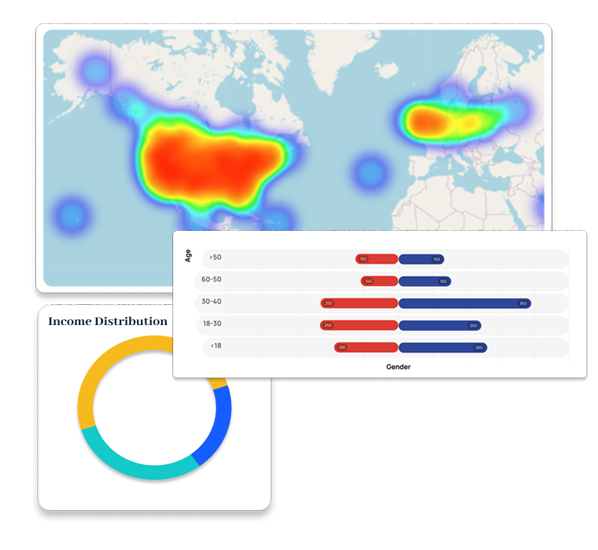
A brand conversation is not one audience speaking with one voice. Different locations, languages, communities, age groups, occupations, and customer segments may react in very different ways.
Kommon Poll helps teams interpret audience context using available demographic and profile signals. This can reveal which segments are driving conversation, where sentiment differs, and which groups need more focused messaging, support, or research.
The platform is especially useful for multilingual and multi-market environments where location, language, and culture shape perception.
Understand which available audience segments contribute most to the conversation.
Explore where conversations originate and how sentiment differs by region or market.
Identify linguistic and cultural patterns that shape how people talk about your brand.
Each workflow combines monitoring, filtering, AI interpretation, and reporting so the page is useful beyond a simple feature description.
Understand which available audience segments contribute most to the conversation.
Explore where conversations originate and how sentiment differs by region or market.
Identify linguistic and cultural patterns that shape how people talk about your brand.
Use available demographic indicators to understand audience differences with appropriate caution.
Where data is available, explore professional and socioeconomic context behind conversations.
Compare positive, negative, and neutral sentiment across audience groups and channels.
Use these examples as starting points for configuring searches, alerts, dashboards, and reports around the outcomes your team needs.
Kommon Poll is designed to make public conversation easier to operationalize: define the scope, collect the signal, interpret the pattern, and share what matters.
Gather mentions from channels where audience or profile signals may be available.
Classify mentions by location, language, platform, topic, and available demographic indicators.
Identify differences in sentiment, themes, complaints, and channel behaviour.
Use findings to shape messaging, content, support, campaigns, and market research.
No. Availability depends on the source, public data, and privacy constraints. Kommon Poll uses available signals responsibly and avoids overclaiming where data is incomplete.
Yes. Location and language comparisons are often among the most useful ways to understand audience differences.
They should guide hypotheses, messaging, and research priorities, not replace direct customer research or responsible human judgement.
Connect this page with adjacent workflows so users can understand the broader value of public conversation intelligence.
Use Kommon Poll to explore who is talking, where they are talking, and how their needs differ.